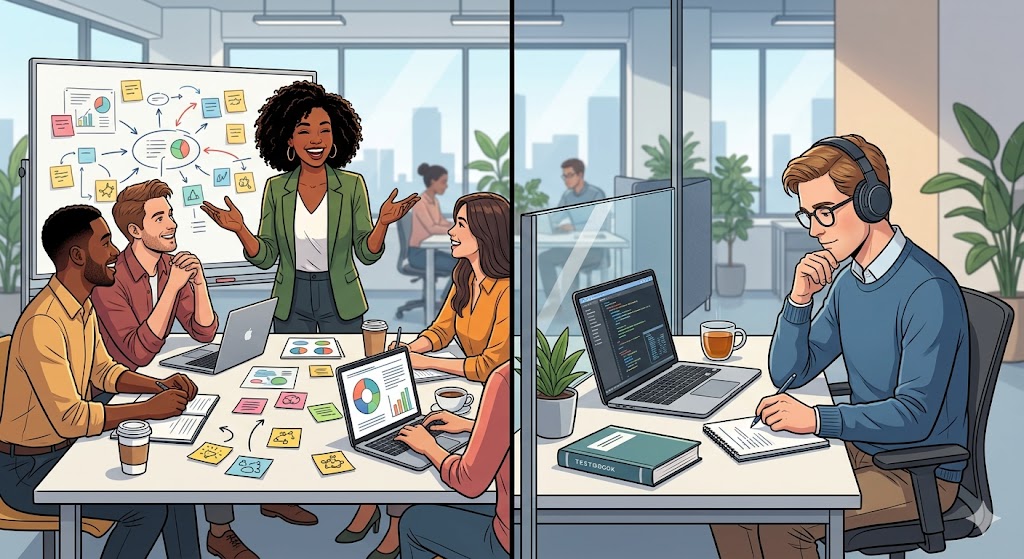
The introvert vs extrovert at work divide shows up in ways most offices never account for. You do good work. You know you do. But somehow, the office still feels like a place that was built for someone else entirely.
The meetings that could have been emails. The open floor plan where someone is always watching. The colleague who thinks out loud through every problem while you’re still processing the first sentence. It’s not that you hate your job. It’s that the way work is structured seems to reward a kind of energy you don’t naturally have — and drain the kind you do.
That feeling isn’t a character flaw. It has a real explanation.
Introvert vs Extrovert at Work: What’s Actually Going On
Carl Jung was the first to name introversion and extroversion as personality orientations, but the modern science goes deeper than his definitions. One of the clearest biological explanations involves neurotransmitters. Extroverts tend to get a strong reward response from dopamine — the chemical released during social interaction, novelty, and external stimulation. Their brains essentially say more of that, please.
Introverts respond more to acetylcholine — a neurotransmitter linked to focused attention, long-term memory, and internal reflection. It’s activated by quieter, more deliberate thinking. This means introverts aren’t avoiding stimulation because they’re shy or antisocial. Their nervous systems genuinely process external input more intensely. A loud brainstorm session, a busy lunch crowd, back-to-back video calls — these register differently in an introverted brain.
In the Big Five personality model, introversion correlates with lower extraversion — meaning less of a need for external stimulation to feel motivated or content. Neither is better. They’re just different fuel systems, running on different sources.
The Signs You Might Be Experiencing This
You might notice that you do your best thinking after the meeting, not during it. The right words arrive on the walk home, not at the whiteboard.
It often looks like always being the one who prepared more than anyone else — but still feeling like you’re performing rather than contributing, because the format doesn’t match how you actually think.
You might notice that small talk with coworkers before a presentation costs you something. Not socially. Energetically. Like your battery was already at 40% before the real thing even started.
It can also look like preferring a detailed brief over a spontaneous kickoff call. Wanting time to think before you respond. Finding that one long focused stretch of work leaves you feeling good, while three hours of fragmented tasks and check-ins leaves you with the kind of tired where even texting back feels like too much.
And it might look like watching an extroverted colleague speak up confidently in a room and wondering why that feels so effortless for them — when it never quite feels effortless for you.
What This Actually Looks Like
Sam is a project manager at a mid-size agency. On paper, the job suits her — she’s organized, thoughtful, good with clients. But every Tuesday there’s a team standup, then a client call, then a working lunch someone scheduled without asking.
By 2pm she’s staring at her screen unable to write a single coherent sentence. Her extroverted colleague posts three Slack updates before noon and seems genuinely energized by the chaos. Sam used to think something was wrong with her. Now she knows her brain spent six hours processing other people’s energy, and it simply needs time to recover. So she blocks 2–4pm on her calendar as focus time. Non-negotiable. That one change made the job feel survivable again.
What Tends to Help
First, protect your deep work time like it’s a meeting with someone important — because it is. Block it in your calendar. Name it something others won’t question, like “Project Focus” or “Heads Down.” Most people won’t push back if it looks official.
Second, when you have something valuable to contribute in a meeting but didn’t get the chance, send a follow-up message afterward. Email, Slack, a short note. Your ideas don’t expire when the call ends. This isn’t a workaround — it’s actually often more useful than what was said in the room.
Third, give yourself a transition ritual between work and home. Even ten minutes of walking without a podcast. Your nervous system needs a gear change, not just a location change.
Fourth, stop apologizing for how you prefer to receive information. “Can you send me the details so I can think it over?” is a completely reasonable sentence. You don’t have to perform instant reactions.
Fifth, identify the one or two people at work you can actually recharge around. Not every colleague costs you energy. Some feel easy. Invest in those relationships specifically.
When to Get Some Support
If you’re regularly leaving work feeling not just tired but genuinely hollowed out — like you’ve lost access to yourself — that’s worth paying attention to. Introversion explains a lot, but it doesn’t explain everything. Chronic workplace anxiety, burnout that doesn’t lift on weekends, or a persistent feeling of dread on Sunday nights can signal something that goes beyond personality type. Talking to a therapist, especially one familiar with highly sensitive people or burnout, can help you separate what’s your wiring from what’s an environment that’s genuinely not working.
A Few Questions Worth Answering
Can introverts be good leaders?
Yes — and research backs it up. Introverted leaders tend to listen more carefully, prepare more thoroughly, and let team members take initiative. They’re often better in one-on-one conversations and less likely to dominate a room at the expense of others’ ideas. Different style, not a lesser one.
Why do introverts hate open offices?
Because an open office is basically continuous low-level stimulation with no off switch. Unpredictable noise, visual movement, the social pressure of being visible — all of it costs introverts more cognitive energy than it costs extroverts. It’s not about being antisocial. It’s about how your brain processes constant input.
Do introverts work better alone?
Often, yes — for certain kinds of work. Deep thinking, writing, analysis, problem-solving. But introverts can also collaborate well, especially in smaller groups with clear structure and time to prepare. The difference is that they usually need recovery time after, not more social time.
Is it introversion or social anxiety?
Introversion is about energy — social situations drain you. Social anxiety is about fear — social situations make you expect judgment or rejection. They can overlap, but they’re not the same. An introvert can feel perfectly calm in a crowd, just exhausted afterward. Anxiety feels more like dread before, and relief when it’s over.
The introvert vs extrovert at work gap isn’t something you can wish away, but you can plan around it. Work was largely designed around extroverted defaults — open spaces, verbal brainstorming, spontaneous collaboration. That’s not a moral failing of extroverts. It’s just how most offices evolved. Knowing that doesn’t fix the Tuesday standup, but it might mean you stop spending energy wondering what’s wrong with you — and start spending it on figuring out what actually works for your brain.