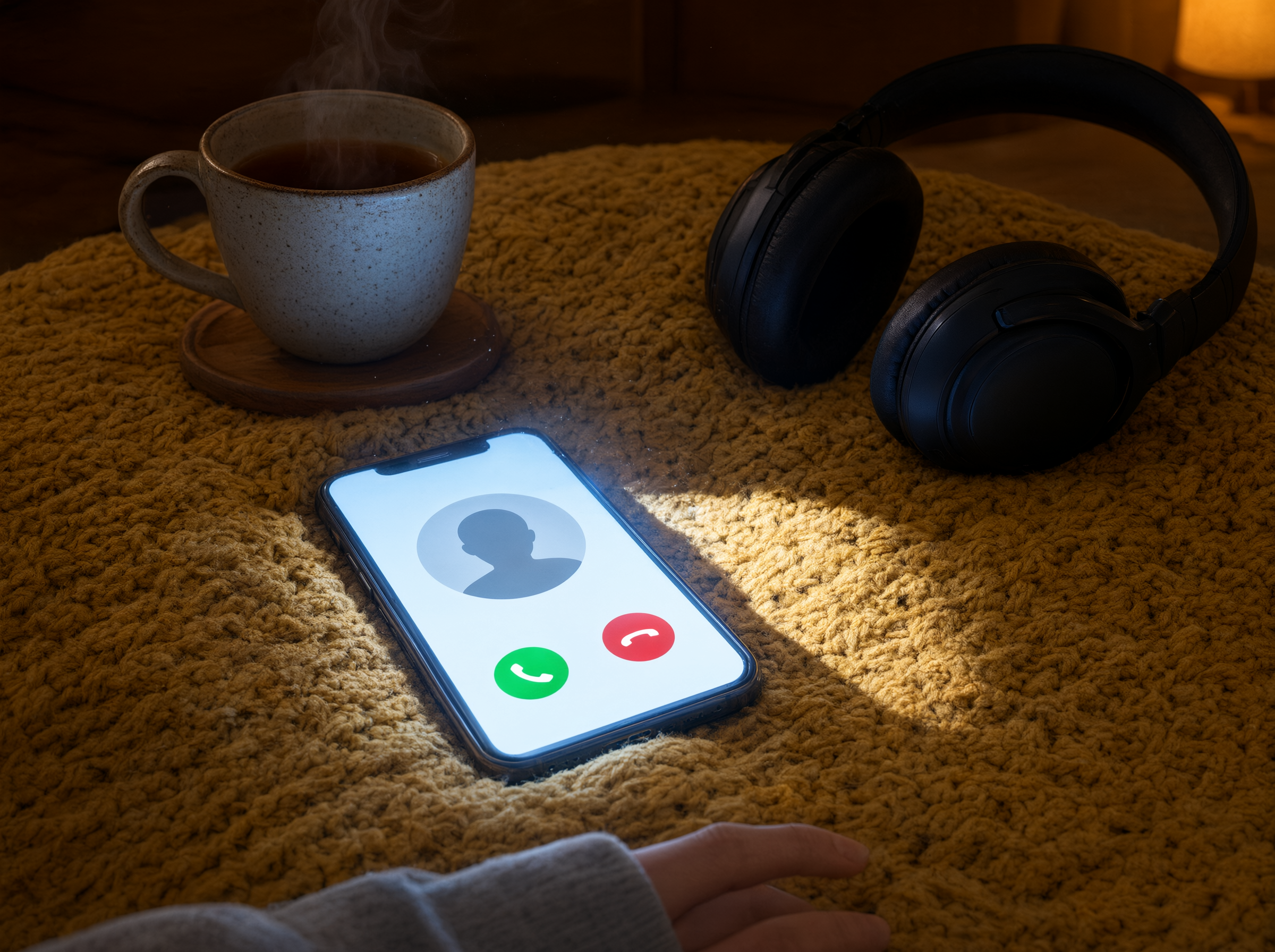
The phone rings, you see the name of someone you genuinely like, and your first feeling is a small drop in the stomach. You let it go to voicemail. Then you text them: “sorry, missed you — what’s up?”
This is one of the most reliably reported introvert experiences there is, and it is also one of the most misunderstood, because from the outside it looks like avoidance of the person. It is not. It is avoidance of the format.
Here is what is actually happening.
1. There is no warning
Everything else in your communication life comes with a buffer. An email sits until you open it. A text can be read now and answered in an hour. A meeting appears in a calendar days ahead.
A phone call is an interrupt. It demands that you switch from whatever you were doing into full social performance in about two seconds, with no time to compose anything.
For a temperament whose defining feature is processing before responding, this is the worst possible interface. It removes the single thing you rely on. You are not bad at the conversation — you are being asked to have it without the preparation step that makes you good at it.
2. There is no exit
Every other social format has a visible end. A coffee ends when the cups are empty. A meeting ends at the time on the invitation. Even a party has a door.
A call ends when someone decides to end it, and ending it is an active social move that requires a plausible reason. Which means when you pick up, you are agreeing to an interaction of unknown length with no built-in escape.
This matters far more to an introvert than to an extrovert, because you are working from a finite budget and you have just been asked to commit an unspecified amount of it. If you have read how the social battery works, this is that mechanic in its purest form.
3. The face is missing
This is the part people get backwards. The common assumption is that calls should be easier than meeting in person, because there is no eye contact and no body to manage.
In practice a call is harder, because you have lost half the information channel while keeping all of the real-time pressure. In person you can read whether someone is amused, finished, or about to speak. On a call all of that collapses into audio, and you get the specific horror of the phone conversation: two people starting a sentence at the same time, both stopping, both saying “sorry, go ahead.”
For someone already inclined to monitor how they are landing, working blind is exhausting. Video calls fix some of this, which is why plenty of introverts prefer video to voice despite it being more exposing — the feedback is restored.
4. It is disproportionately small talk
Most calls do not begin with the point. They begin with a warm-up: how are you, how was the weekend, weather, general throat-clearing. The actual content arrives in minute four.
Text lets you skip straight to the content without rudeness. A call requires the ritual, and small talk is precisely the category of interaction with the worst cost-to-value ratio for an introvert. You are paying full social price for the low-value part of the exchange before you are allowed near the useful part.
Is it introversion or is it anxiety?
Worth checking honestly, because the two produce identical avoidance and need different responses.
Introversion looks like: I could do this call perfectly well, I just do not want to spend the next twenty minutes and the recovery afterwards. You are annoyed at the cost, not frightened.
Phone anxiety looks like: heart rate climbing before you dial, rehearsing the opening line repeatedly, physical relief when it goes to voicemail, and afterwards a replay of everything you said. That is a specific and very common anxiety — and unlike introversion, it shrinks with graded exposure.
Many people have both. The tell is what happens in your body before you dial.
What to do about the calls you cannot avoid
Reply by text with a time. “Can’t talk right now — free at 4, or happy to sort it here.” This is not evasive. It converts an interrupt into an appointment, which is the entire problem solved in one message.
Write three bullets before you dial. Why you are calling, the two things you need, and one line to close with. Ninety seconds of preparation removes most of the dread, because the dread is mostly about being unprepared in real time.
Have an exit line ready. “I’ll let you go — I’ve got something at half past.” Say it warmly and say it early. The absence of a natural ending is a real structural problem with the format, and the solution is to bring your own.
Batch them. Put the three calls you owe into one block on one afternoon. One recovery period instead of three interruptions spread across a week.
Ask for the agenda first. For work, “can you send me what you need and I’ll come back with answers?” is an entirely normal professional request that also happens to play to your strengths. More on this in professional communication for introverts.
Use video where you can. Restoring the visual channel removes the interruption-collision problem and the guesswork about how you are landing.
When to just pick up
There is a category where holding out for text costs you more than the call would.
Anything with emotional weight or conflict. Tone does not survive text, and a disagreement conducted over messages usually takes three times as long and ends worse. See how introverts handle difficult conversations.
Anything that would take more than five exchanges. If you are heading for a fourteen-message thread, the four-minute call is cheaper in every currency including yours.
Close relationships where distance is growing. This is the honest one. Texting is more comfortable but thinner, and a friendship maintained exclusively by text can quietly flatten out over a year or two. Occasional calls are load-bearing for the people who matter, and preferring text is not a good enough reason to let those go.
The one thing to tell people
Most of the friction here disappears with a single sentence, delivered once, to the people who call you:
“I’m bad on the phone — nothing personal, I just do much better if you text first and we set a time.”
People accept this immediately and remember it. Almost nobody is offended. What offends people is the pattern without the explanation: repeatedly missed calls, delayed replies, and no stated reason — at which point they reasonably conclude something about how much you care.
The dread is real and the format genuinely is worse for you than for other people. But the silence around it is the part that costs you relationships. Explain it once and most of the problem goes away.
Questions People Ask About Introverts and Phone Calls
Why introverts hate phone calls more than meetings
Why introverts hate phone calls comes down to synchronicity without visual cues: you must respond instantly, with no face to read and no way to see the end coming.
Is phone call anxiety the same as social anxiety?
Phone call anxiety can exist entirely on its own. Plenty of people who present confidently in person still hate talking on the phone.
Why do I hate talking on the phone but like the person calling?
Because the medium is the problem, not the relationship. Why introverts hate phone calls has nothing to do with who is on the other end.
What helps with phone anxiety introvert readers describe?
Phone anxiety introvert readers report eases with scheduled calls, a written agenda and permission to say you will follow up in writing.