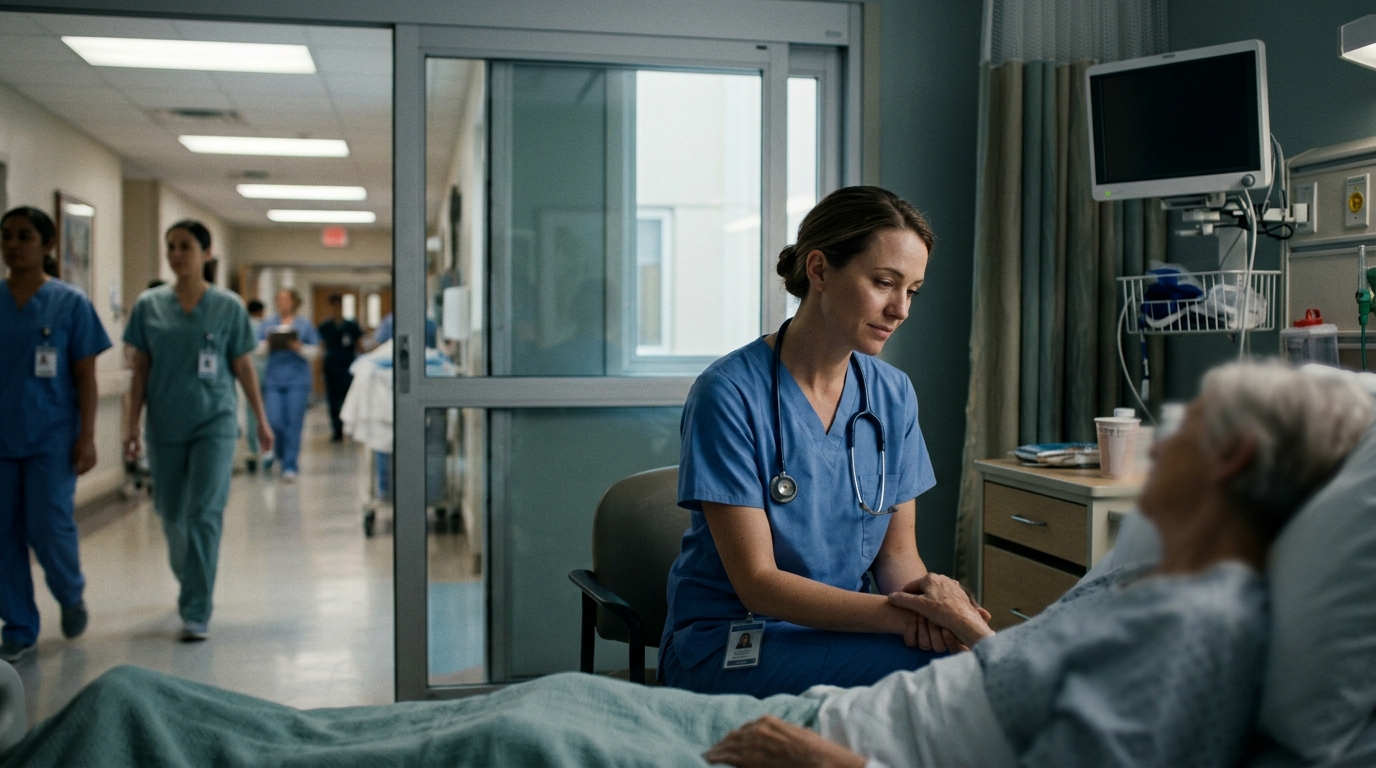
Nursing as an introvert, can It work? yes, and introverts are frequently very good at it — the noticing, the one-to-one attention, the calm under pressure are all things this temperament produces naturally. What makes it hard is not the patients. It is the ward: continuous noise, constant interruption, no recovery window in a twelve-hour shift, and a handover that never stops.
What introverted nurses are good at
Noticing early. The change in breathing, the patient who has gone quiet, the family member who is not coping. Deep processing plus close attention catches things that are not yet on any chart, and this is consistently what colleagues name.
One-to-one care. The format where this temperament is strongest, and it is where most actual nursing happens.
Calm. Not escalating when a situation is already loud is genuinely valuable, and patients and families respond to it.
Listening. Patients tell things to the nurse who is not filling the silence. That produces information other people do not get.
Thoroughness. Checking, documenting, catching the discrepancy.
What actually makes it hard
None of this is about being bad with people.
The sensory environment. Alarms, lights, conversation, machinery, twelve hours without quiet. For a lower stimulation threshold this is the largest single cost and it is continuous.
Interruption as the job. The work is a stream of demands requiring immediate response. There is no descent into depth and no protected block.
No recovery window. A shift has no gap in it. Breaks are frequently taken in a busy staff room, which is not recovery.
Emotional load with limited agency. Exposure to distress you cannot always resolve is the specific combination that burns people out — and this temperament registers more of it.
The social layer. Handover, the team, the staff room, the WhatsApp group. A second job running alongside the first.
What helps on shift
Take the break away from the staff room. The single most useful change. Outside, the car, an empty corridor, anywhere quiet for fifteen minutes. Eating in a busy room with colleagues is pleasant and it is not restoration.
Use the quiet tasks deliberately. Drug rounds, documentation, restocking. Where the work allows, these are recovery inside the shift.
Protect the commute. Silence rather than a podcast, on the way home at least. For many nurses this is the only genuinely uninterrupted time in the day.
Do not schedule anything after a long shift. Not a preference — arithmetic.
Guard the day off. One day of nothing after a run of shifts, decided in advance rather than hoped for.
Which specialties suit this temperament
The most actionable part, because the variation between settings is enormous.
Generally easier: district and community nursing, practice nursing, palliative care, theatre and recovery, occupational health, research nursing, specialist nurse roles, night shifts on quieter wards, dialysis, endoscopy.
What these share: fewer simultaneous patients, more one-to-one time, a more predictable rhythm, and in several cases a quieter physical environment.
Generally harder: busy A&E, acute medical admissions, and any understaffed ward where the interruption rate is unmanageable.
Not impossible — several introverted nurses do emergency work well and specifically value the focus that a crisis produces. But it is the setting that demands the most, continuously.
The burnout warning
Worth being direct about, because nursing has high attrition and this temperament is exposed in a particular way.
The risk is not that you dislike the work. It is that you are good at it, absorb more, say less about the cost, and have no natural stopping signal — while the environment supplies no recovery at all.
The signs arrive as dread of the ward rather than of the patients, longer recovery after each run of shifts, and the Sunday feeling starting on Friday. See burnout at work.
The structural answer is usually a change of setting rather than a change of profession. Moving from an acute ward to community nursing changes the daily load more than any coping strategy will.
Handover and the team
The two social parts of the job that cost most and get least attention.
Handover is a high-stakes verbal performance under time pressure — the format this temperament is worst at. Two things help: write your notes in advance in the order you will say them, and use a structured format consistently so you are not composing while speaking.
The team. Complete withdrawal from the staff room has a real cost — information circulates there, and so does goodwill. Ten minutes at the start of a break, three shifts a week, does most of the work at a fraction of the price of being present throughout.
Night shifts
Worth a note, because many introverted nurses gravitate toward them and it is not a coincidence.
Nights are quieter, the interruption rate is lower, there are fewer staff and fewer visitors, and the work is more autonomous. For this temperament that is a substantially better environment.
The trade is real: disrupted sleep affects everything, and shift work has genuine long-term health considerations. It is worth choosing deliberately rather than drifting into permanently, and worth protecting sleep with the same seriousness you would protect a clinical standard.
If you are considering nursing
Two things worth knowing before you decide.
Being introverted is not a reason to rule it out. The qualities the profession most needs — attention, calm, thoroughness, genuine listening — are the ones this temperament produces without effort.
But the environment matters more for you than for most people, and it is worth choosing deliberately rather than taking whatever post comes first. Ask about staffing levels, patient numbers per nurse, and whether breaks actually happen.
Related: jobs for highly sensitive people and best jobs for introverts.
Questions People Ask About Nursing as an Introvert
Can you be a nurse if you are an introvert?
Can you be a nurse if you are an introvert? Yes, and introverts are frequently very good at it — noticing, calm, and strong one to one.
What is life like as an introverted nurse?
An introverted nurse usually finds the patients manageable and the ward exhausting: continuous noise, interruption and no recovery space.
Is nursing for introverts sustainable long term?
Nursing for introverts is sustainable in the right setting. Can you be a nurse if you are an introvert depends heavily on which unit.
What are the best nursing jobs for introverts?
The best nursing jobs for introverts include district nursing, theatre, research, occupational health and specialist clinics.