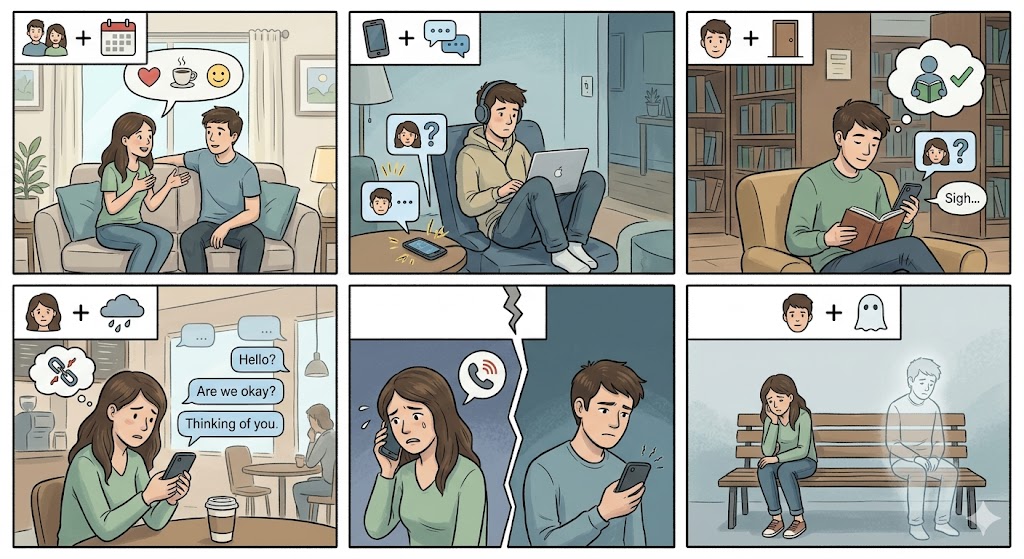
Introvert ghosting is one of the most misread behaviours in relationships. You stop replying. You cancel plans. You disappear — not out of malice, but because something inside you just ran out. The people on the receiving end feel hurt and confused. You feel guilty and even more drained. Neither of you quite understands what happened.
What Introvert Ghosting Actually Is
Introvert ghosting is not the same as the cold, calculated silence someone uses to avoid a difficult conversation. It is usually a response to depletion. When an introvert’s social and emotional resources are used up — through too much contact, too many demands, or an interaction that felt unsafe — withdrawal becomes automatic. It is not a decision so much as a shutdown.
Psychologically, introverts process social interaction through longer neural pathways than extroverts do. Research on dopamine sensitivity suggests that introverts are more easily overstimulated by external input, including emotional input. When that overstimulation crosses a threshold, the nervous system essentially calls for retreat. Responding to messages, making plans, or managing someone else’s feelings can feel genuinely impossible — not difficult, but impossible.
This is not an excuse. It is a mechanism. Understanding it does not mean the behaviour cannot change, but it does mean the cause is rarely what the other person assumes: indifference, disrespect, or a desire to hurt.
How Introvert Withdrawal Shows Up in Relationships
It often shows up gradually, then suddenly. You notice you have been leaving messages on read for three days. A friend invites you somewhere and you intend to reply, genuinely, but the days pass. A romantic partner texts twice and you feel a strange paralysis every time you see their name on the screen. It is not that you do not care — it is that responding feels like lifting something very heavy when you have no strength left.
Introverts withdrawing from relationships sometimes disappear from multiple people at once during high-stress periods. It is rarely personal, even when it feels personal to whoever is waiting. You might also notice that the withdrawal intensifies after social events, conflict, or periods where you felt pressured to be more available than you actually were. The silence is the pendulum swinging back.
There is also a shame loop involved. The longer the silence goes, the harder it becomes to break it — because now an explanation feels required, and explaining requires more energy than you have.
What Actually Helps
The most useful thing you can do is shorten the gap between noticing the withdrawal and saying something small. You do not owe anyone a full explanation of your inner state. A two-line message — “I’ve been overwhelmed and gone quiet. I haven’t forgotten you” — does more than a perfectly worded apology written three weeks later.
Set a contact rhythm that is honest about your actual capacity. If daily texting depletes you, say so early in a relationship rather than complying until you collapse. People can handle “I go quiet sometimes, it’s not about you” far better than they can handle unexplained silence.
When you feel the shutdown coming, try naming it to yourself first. “I am approaching my limit” is more useful internal language than “I just need space” — because it points to a specific cause rather than a vague preference. That clarity can help you communicate before you disappear rather than after.
Why introverts go silent is often about energy, not emotion. But the people in your life experience it emotionally. Closing that gap — even imperfectly — protects relationships that matter to you.
When to Get Support
Introvert social withdrawal becomes worth examining with a professional when it is causing you to lose relationships you value, when the shame spiral around it is severe, or when you notice it is not just about energy but about fear — of conflict, rejection, or emotional intimacy. A therapist who understands introversion can help you separate protective solitude from avoidance that is quietly costing you.
A Few Questions Worth Answering
What is introvert ghosting really?
Introvert ghosting is usually accidental drift rather than a decision — a postponed reply that compounds until the silence itself is the obstacle.
Why do introverts ghost people they like?
Why do introverts ghost people they like comes down to capacity. A reply that deserves thought waits for energy that never arrives.
Is introvert disappearing a relationship red flag?
Introvert disappearing becomes a red flag only if it does not reverse. Introvert ghosting that resolves on its own is a pattern, not a verdict.
What does it mean when an introvert stops replying relationship wise?
When an introvert stops replying relationship questions usually have a simpler answer than rejection: the backlog got too large to face.
- Is introvert ghosting a form of emotional avoidance?
-
Sometimes, yes. Introvert social withdrawal can be pure energy management, but it can also be avoidance of difficult emotions or conversations. If you consistently go silent when a relationship gets more demanding or vulnerable, that pattern is worth looking at honestly.
- Why do introverts go silent even with people they care about?
-
Because depletion does not discriminate. When an introvert’s social capacity is exhausted, closeness does not automatically restore the ability to engage. Caring about someone and having the energy to respond to them are two separate things — and introverts feel that gap acutely.
- How should someone respond when an introvert ghosts them?
-
One calm, low-pressure message is enough. Something like “no rush, just checking you’re okay” removes the pressure without punishing the silence. Repeated messages or expressions of hurt during the withdrawal rarely help — they usually deepen the paralysis.
- Can introverts change this pattern in relationships?
-
Yes, with awareness and practice. The change usually comes not from forcing yourself to respond when depleted, but from communicating your limits before you hit them, and learning to send small signals rather than disappearing entirely. It takes time, but the pattern is not fixed.
Introvert ghosting tends to be about capacity, not character. That does not make it painless for the people affected — and it should not be used as a permanent excuse. But if you recognise this pattern in yourself, the most honest starting point is simply this: your silence communicates something, whether you intend it to or not. Small words, sent early, carry more weight than you might think.
Related reading
- Why Introverts Are Bad at Texting Back — the texting backlog behind it.
- Introvert vs Extrovert in Relationships: What Changes
- Introvert and Insomnia: Why It Happens