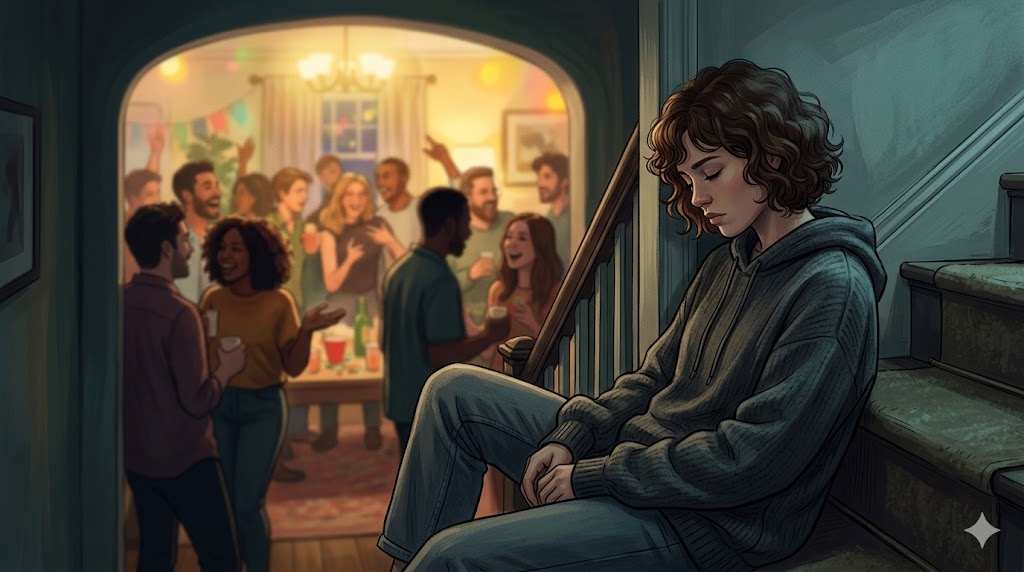
Introvert social exhaustion is not shyness, and it is not a mood. It is a physiological state — your nervous system has taken in more stimulation than it can process, and now it is demanding recovery time. If you have ever left a perfectly fine gathering and felt oddly hollowed out, irritable for no clear reason, or desperate to be alone even from people you love, that is what this feels like.
Why Introvert Social Exhaustion Happens
The most widely cited explanation comes from neurological research on how introverts and extroverts process dopamine differently. Introverts tend to be more sensitive to dopaminergic stimulation, meaning the same social environment that energises an extrovert can tip an introvert into overload. Carl Jung first described introversion as a preference for the inner world over the external — but the mechanism behind it is biological, not a choice or a weakness.
Social interaction requires continuous cognitive processing: reading facial expressions, managing what you say, tracking the emotional temperature of the room, performing small talk you did not ask for. For introverts, this processing draws heavily on mental resources. The acetylcholine pathway, which supports calm, focused inner activity, is dominant in introverted brains. When external demands override that internal rhythm, the system eventually hits a wall.
Introvert social exhaustion is not caused by disliking people. You can genuinely enjoy a conversation and still feel wrecked afterward. The two things are not in conflict.
Signs You Are Already Depleted
Social energy depletion often does not announce itself clearly until you are well past the point of easy recovery. You might notice that small decisions feel disproportionately hard — what to eat, what to reply to a text. This mental fog is a reliable early sign that you have been running on fumes socially.
It often shows up as a flattened emotional state. Not sadness exactly, but a kind of grey numbness where things that normally interest you feel distant. You might find yourself snapping at someone close to you, not because they did anything wrong, but because your tolerance for input — any input — has dropped to almost nothing.
Physical signs are real too. A dull headache after long social days, a tight feeling in the chest or shoulders, needing more sleep than usual but finding it harder to settle. Introvert burnout does not always feel dramatic. Sometimes it just feels like wanting to cancel everything and stare at the ceiling, which is your nervous system asking, not unreasonably, for quiet.
What Actually Helps With Recovery
The most effective recovery from introvert social exhaustion is unstructured solitude — not solitude with a task attached to it, but time where nothing is required of you. This means resisting the urge to fill the quiet with podcasts, scrolling, or productive activities. Passive rest does something active rest cannot: it lets the brain shift into its default mode network, which is associated with consolidation and restoration.
Set a hard limit on re-entry. After a socially demanding stretch, do not book anything for at least one full day if you can manage it. This is not being antisocial. It is managing a finite resource responsibly.
Spend time in low-stimulation environments. Outside in a quiet place, in a room without screens, with a book that does not demand much. Recovering from overstimulation means reducing inputs, not replacing one kind of noise with another.
When you leave a gathering before you would like to stay, do not apologise or over-explain. A simple “I’m heading off” is enough. Every apology you add costs you a small piece of energy you need back.
Pay attention to the ratio of draining to restoring activities across your week, not just on individual days. Introvert burnout tends to build slowly across weeks of slight overdraft, not from a single long evening.
When to Get Support
If social exhaustion is a recurring state rather than an occasional one, and rest no longer fully restores you, that is worth taking seriously. Chronic introvert burnout can shade into anxiety or depression, and those conditions do not resolve with solitude alone. A therapist who understands introversion — not one who treats it as a problem to fix — can help you identify patterns that are genuinely unsustainable. That is a useful conversation to have before you hit a wall you cannot climb over.
A Few Questions Worth Answering
- Is introvert social exhaustion the same as social anxiety?
-
No. Social anxiety involves fear or dread around social situations. Introvert social exhaustion is about energy depletion after social interaction, not before or during it. An introvert can feel perfectly comfortable in a group and still need significant recovery time afterward. The two can coexist, but they are separate things.
- How long does it take to recover from introvert burnout?
-
A single overstimulating event might require a few hours to a full day of quiet. A prolonged stretch of social overdraft — several weeks of too much interaction — can take days or even a couple of weeks to genuinely resolve. The longer the depletion, the longer the recovery. Sleep alone is rarely sufficient.
- Can introverts build more social stamina over time?
-
Somewhat. Familiarity with a group reduces the cognitive load of interaction, which makes those specific situations less draining. But the underlying wiring does not change. What improves is your ability to recognise your limits earlier and manage your schedule around them — not an unlimited capacity for socialising.
- Why do I feel guilty for needing so much alone time?
-
Because most social environments are designed around extroverted norms, and needing to withdraw gets interpreted as rejection. It is not. Recovering from social energy depletion is a functional necessity, not a character flaw. The guilt is learned. It does not reflect anything true about your value as a friend or person.
Knowing your pattern is the most practical thing you can take from this. Introvert social exhaustion follows a logic you can learn to read — in your body, in your mood, in the quality of your thinking. The earlier you catch it, the less recovery costs you. That is not a limitation. It is just how your system works.