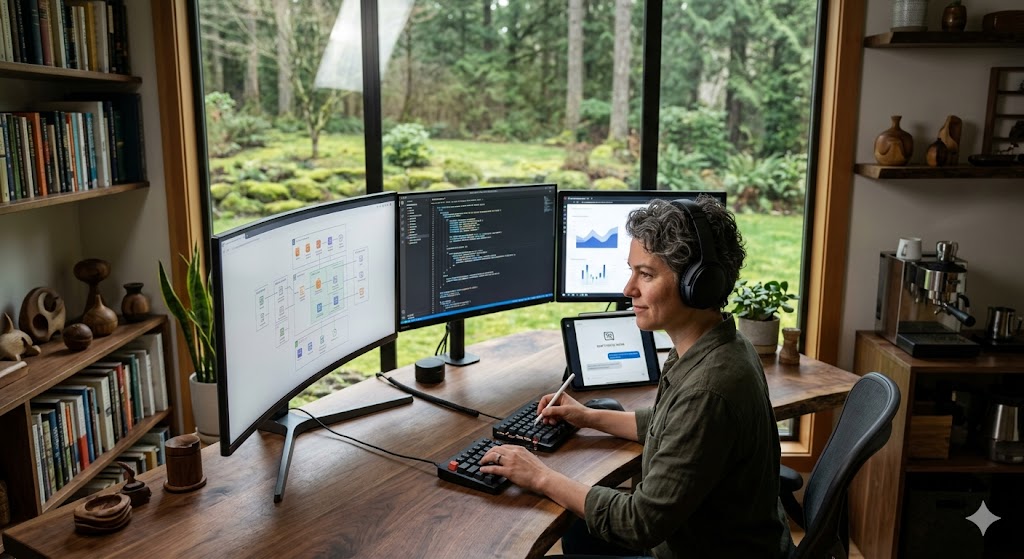
The best remote careers for introverts aren’t just about avoiding the office. They’re about finding work that fits the way your mind actually operates — independently, deeply, without constant interruption. If you’ve spent years exhausted by open-plan offices, back-to-back meetings, and the expectation to be visibly enthusiastic all day, remote work isn’t a luxury. For many introverts, it’s the difference between functioning well and barely getting through the week.
Why Remote Work Suits Introverted Thinking
Introversion, as Carl Jung originally described it, is about where you direct your attention and where you restore your energy. Introverts tend to process internally — they think before speaking, prefer depth over breadth, and do their best work without constant social noise in the background. That’s not a weakness. It’s a cognitive style that happens to be poorly served by traditional office environments.
Research on the Big Five personality traits consistently shows that introverts score lower on extraversion but not on capability, ambition, or output. In fact, remote work conditions — fewer interruptions, control over your environment, asynchronous communication — often let introverts produce their best work. The dopamine-driven social stimulation that energises extroverts can actively impair an introvert’s concentration.
Remote work removes most of those friction points. You decide when to respond to messages. You don’t have to perform alertness in a meeting when you’d rather be thinking. The career paths that work best in this context tend to reward sustained focus, written communication, and independent problem-solving — all areas where introverts often genuinely excel.
Signs You’re in the Wrong Career Environment
You might notice that Sunday evenings feel disproportionately dread-filled — not because the work itself is hard, but because of everything surrounding it. The commute, the small talk, the open-plan noise, the pressure to seem engaged during meetings that could have been an email. These aren’t signs of weakness. They’re signals that your environment is working against your wiring.
It often shows up as chronic low-grade exhaustion that sleep doesn’t fix. Or a pattern of doing your clearest thinking after everyone else has logged off. You might find that your written communication is sharper than your verbal, or that you do better work on solo projects than in group settings — not because you’re antisocial, but because you think more clearly with space.
If you recognise this, the answer isn’t to push harder at performing extroversion. It’s to find remote work for introverts that is structured around output, not presence.
Remote Careers for Introverts Worth Considering
Software development and programming remain among the strongest options. The work is largely independent, communication is often asynchronous, and results speak for themselves. You don’t need to be the loudest person in a room — you need to write clean code. Many developers work entirely remotely with minimal meetings, especially in smaller companies or as freelancers.
Technical writing is underrated and well-paid. It involves translating complex information into clear documentation — manuals, API guides, help centres. It suits introverts who like precision and depth, and most of the work happens solo, communicated through written drafts rather than meetings.
Data analysis and research roles are another strong fit. Whether in market research, academic research, UX research, or business intelligence, these roles reward patience, pattern recognition, and the ability to sit with a problem long enough to understand it properly. Most deliverables are written reports or presentations prepared independently.
Graphic design and illustration suit introverts who think visually. Freelance designers often work with minimal back-and-forth — a brief, a deadline, a finished file. The best jobs for introverts in this space allow you to build a client base where communication is structured and time-bounded.
Copywriting and content strategy are worth mentioning separately from technical writing. If you read widely, think carefully about language, and prefer expressing yourself in writing rather than conversation, this path has genuine depth. Senior content strategists are well-compensated and rarely need to be on camera.
Accounting, bookkeeping, and financial analysis round out the list. Numbers-focused roles often require concentrated solo work, clear deliverables, and limited spontaneous social demands. Many firms now operate entirely remotely.
What Actually Helps You Succeed in These Roles
Build your asynchronous communication skills deliberately. Write clearly, answer fully the first time, and structure your messages so people don’t need to follow up. This is what earns trust in remote teams without requiring you to be constantly available.
Protect your deep work hours. If you have any schedule flexibility, block two to three hours in the morning before checking messages. Most meaningful work happens in that window. Treat it as non-negotiable, not aspirational.
When you’re job searching, look specifically for roles that describe output-based expectations — project deliverables, written communication, asynchronous collaboration. Be cautious about roles that emphasise “high energy team culture” or “always-on communication.” Those phrases mean something specific.
Set up your physical workspace to support concentration. This doesn’t require expense — it requires consistency. A space where you only work, good enough lighting, and minimal visual clutter will do more for your output than any productivity system.
When to Get Support
If you’ve been in the wrong career environment for years and you’re experiencing more than tiredness — persistent anxiety, difficulty concentrating even in quiet conditions, or a sense that something is fundamentally wrong — that’s worth speaking to someone about. A career counsellor who understands introversion can help you identify specific paths. A therapist can help if burnout has gone deeper than a career change can fix on its own.
A Few Questions Worth Answering
What are the best remote careers for introverts?
The best remote careers for introverts combine asynchronous communication with output that can be inspected — development, writing, analysis, design.
Which remote jobs for introverts are genuinely quiet?
Remote jobs for introverts vary enormously. A remote role with six daily calls is not quieter than an office; remote careers for introverts should be judged on meeting load.
What work from home introvert careers pay well?
Work from home introvert careers that pay well are usually technical, where scarcity of skill sets the rate.
Does remote work suit every introvert?
Remote careers for introverts remove the environmental cost and can add isolation. The best versions keep one reliable contact point.
- What are the highest-paying remote jobs for introverts?
-
Software engineering, data science, and product management consistently pay well and suit remote work for introverts. Technical writing and UX research also offer strong salaries relative to their social demands. Seniority matters more than the specific field — deep expertise in almost any of these areas pays significantly better over time.
- Can introverts succeed in remote jobs that require some client contact?
-
Yes. The difference between occasional structured communication — a weekly call, a written brief — and constant social performance is significant. Many introverts handle client work well when interactions are defined and purposeful. It’s unstructured, unpredictable social contact that depletes energy, not communication itself.
- Is freelancing or full-time remote employment better for introverts?
-
Both work. Freelancing offers more control over communication and schedule but requires managing client relationships and income variability. Full-time remote roles offer stability but vary widely in culture. The right question is whether the specific role and company suit your working style — not the employment model itself.
- How do introverts build a career remotely without networking?
-
Written networking works well — thoughtful comments on professional forums, a clear LinkedIn profile, published work that demonstrates expertise. Best jobs for introverts often come through visible output rather than schmoozing. Build a portfolio, write publicly about your area of knowledge, and let the work create opportunities rather than relying on in-person events.
Remote careers for introverts aren’t about hiding from the world. They’re about working in conditions where your actual strengths — focus, depth, independent thinking — are assets rather than awkward traits to apologise for. Finding the right role won’t make everything easy, but it will stop making everything harder than it needs to be.