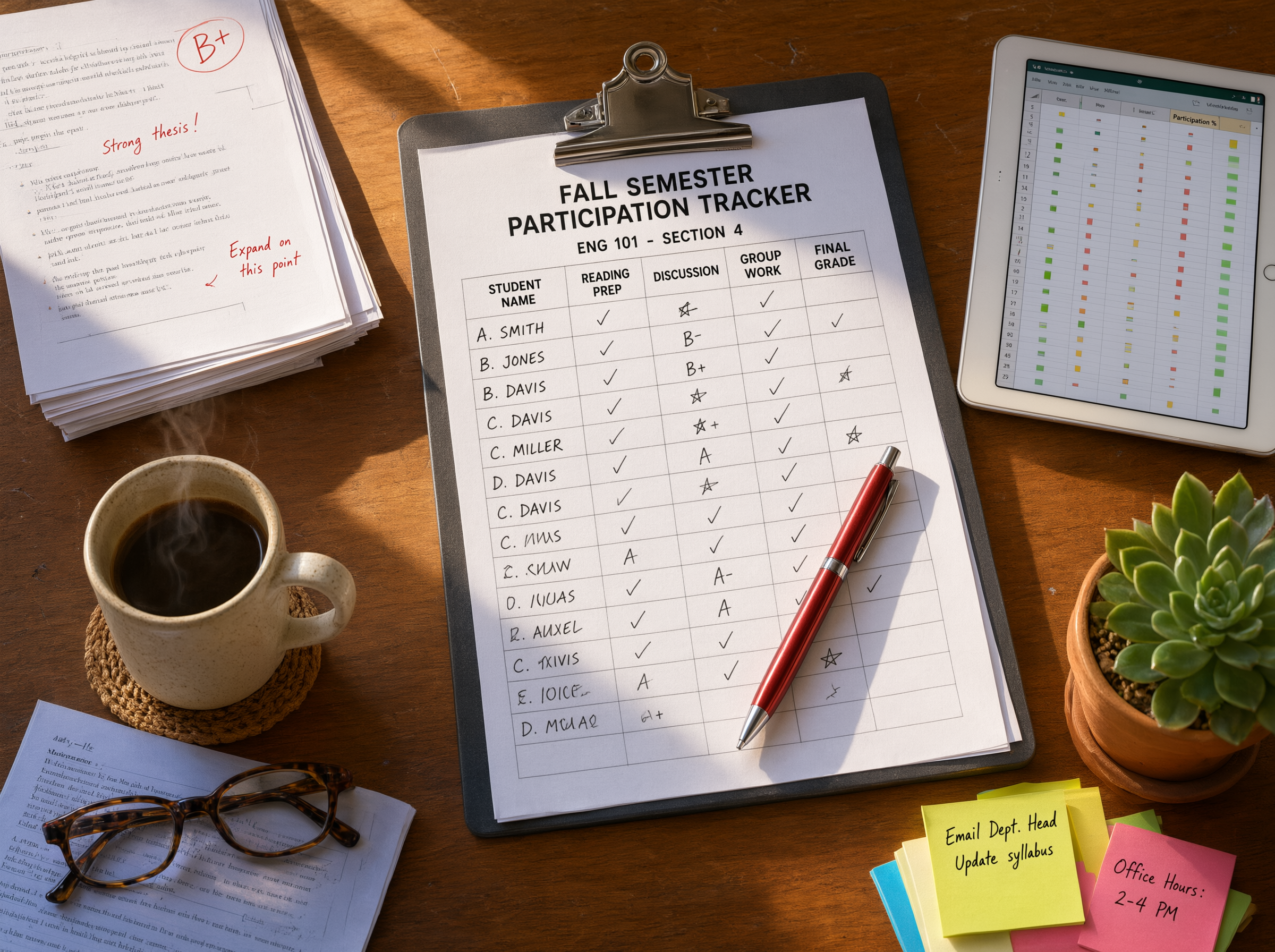
Participation grades, as traditionally implemented, rarely measure what they claim to. Instead, they measure how comfortable a student is speaking in front of thirty people.
While public speaking is a genuine skill, it is not what most subjects claim to assess. This means a significant portion of the grade in many classrooms is awarded for temperament rather than understanding.
But a critique without a solution isn’t helpful to teachers. Here is a look at why the current system is flawed, the valid counter-arguments, and actionable alternatives.
What Participation Grades Actually Measure
Traditional participation grading measures three things, but only one of them is intended:
- Speed of verbal processing: Students who “think out loud” produce answers immediately. Students who process internally before speaking arrive thirty seconds later—by which time the discussion has moved on. The first group appears more engaged, even if they aren’t.
- Comfort with public exposure: Speaking in front of a class is a performance. The willingness to do it repeatedly is largely temperamental.
- Understanding of the material: This is what the grade is supposed to measure, but it is so entangled with the first two that it becomes impossible to separate.
A student can understand a subject thoroughly and score poorly. Conversely, a student can understand it superficially, speak confidently and often, and score well. Any assessment where this is possible is measuring the wrong thing.
The Fairness Argument
Put plainly: if roughly a third to a half of the population leans introverted, a traditional participation grade applies a systematic penalty to a massive group for a stable trait unrelated to academic ability.
We do not grade students on their handwriting speed, how quickly they raise their hand, or how loudly they speak. Participation grades do something very close to all three, yet they are treated as uncontroversial.
The usual defense is that “speaking up is a valuable life skill.” It is. But so is written communication, and so is careful listening neither of which is separately graded in most classrooms.
Steel-manning the Counter-Argument
To be fair, there are valid reasons for participation grades. Dismissing them weakens the argument:
- Discussion is the subject: In seminar-based teaching, languages, or law, the exchange isn’t just a delivery method; it is the learning. A student who says nothing isn’t participating in the subject.
- It builds a necessary skill: A quiet student who never practices articulating a position under mild pressure misses out on a vital skill.
- The “Introvert” excuse: Some students use “I’m an introvert” to avoid academic difficulty rather than to describe a genuine preference. Teachers can usually see this happening.
All three points are fair. However, none of them require the current implementation, which is what the objection is actually about.
What Good Practice Looks Like: 5 Alternatives
Here are five ways to preserve the legitimate goals of participation without penalizing quiet students:
- Embrace written contributions: Define participation to include considered comments submitted after class, questions emailed to the teacher, or written responses to a prompt. Same intellectual engagement, different medium.
- Assess small-group dynamics: Quiet students speak readily in pairs or groups of three. Assessing only whole-class contribution is a choice, not a necessity.
- Provide advance notice: “Next week I will be asking you about section four.” This removes the ambush, keeps the academic demand, and produces a far higher-quality contribution.
- Make the rubric explicit: If participation is graded, students should know exactly what counts and how much. Much of the unfairness stems from implicit criteria and impression-based grading.
- Cap the weight: If participation is worth 30% of a grade, then temperament is worth 30% of a grade. Ten percent is defensible; thirty is not.
The Long-Term Cost: From the Classroom to the Workplace
This is worth arguing about because of the compounding effect over years.
When a quiet student repeatedly receives a lower mark for a trait they cannot change, the message is not subtle: Your way of thinking is worth less; the “correct” kind of student is the one who talks. Delivered from age eleven to eighteen, this becomes a core belief. It manifests in adulthood as imposter syndrome, hesitation to apply for promotions, and reading one’s own carefulness as a deficiency. This is often where “introvert shame” begins.
The exact same mechanism operates in adult workplaces. Performance reviews that reward “visible” contribution, promotion processes that favor confident presenters, and meetings where the first speaker’s idea becomes the default—these are just participation grades for adults.
Actionable Advice
For Students:
- Clarify the rubric: Most participation criteria are implicit. Ask your teacher directly what they are assessing. Frequently, the answer includes things you already do but haven’t made visible.
- The “One Prepared Contribution” rule: Don’t try to become a spontaneous talker. Instead, prepare one thing to say per lesson, and say it early. The first ten minutes of a discussion are much easier to enter than the fortieth. This isn’t capitulating; it’s hacking the system to build a genuinely useful skill.
For Parents: Don’t just object to participation being assessed. Ask the teacher two specific, reasonable questions:
- “What exactly counts as participation, and what proportion of the grade is it?”
- “Does written contribution count? If not, could it?” The second question is frequently adopted because it costs the teacher nothing to implement.
What the Research Says (And Doesn’t)
It’s important to be careful not to overstate the case.
- Reasonably supported: Extending “wait time” after a question changes who answers and improves response quality; introversion is a stable trait present from early childhood; and Western classrooms are structured around group work much more than they were fifty years ago.
- Not established: That quiet students learn more, that participation grades measurably harm long-term career outcomes, or any specific statistical figure for how much of a grade temperament accounts for.
The argument doesn’t need those claims. It rests on a simpler truth: If part of a grade is awarded for a trait unrelated to understanding, that part of the grade is not measuring what it says it is.
Frequently Asked Questions
What is wrong with traditional participation grades? They measure a student’s comfort with public speaking rather than their actual comprehension of the subject matter, effectively grading temperament instead of knowledge.
How do quiet students actually contribute to class participation? Quiet students often provide substantial, invisible participation. They contribute through active listening, deep internal processing, peer-to-peer discussions, and high-quality written work.
Is participation grading inherently unfair? The unfair outcomes are structural rather than intentional. Traditional grading rewards a single, extroverted delivery style while ignoring other valid forms of intellectual engagement.
What assessment methods work better for quiet students? Assessments improve when teachers incorporate written contributions, evaluate small-group work, allow prepared (rather than spontaneous) responses, and make grading rubrics explicitly clear.